

What is a sales funnel?
A sales funnel is a visual representation of the customer journey, starting from the first contact with prospective customers and leading them to the final purchase.
The term “funnel” is commonly used in this context. This is due to its representation of a broad audience at the beginning which progressively narrows down. As potential customers advance through various stages, they are refined into a smaller group. Ultimately, these individuals become the loyal, paying customers situated at the bottom.
Understanding the sales funnel stages
Before exploring the mechanics of a sales funnel, it is important to have a clear understanding of the various sales funnel stages:
1. Awareness Stage {Traffic)
This stage represents the initial phase of the customer journey, where individuals become familiar with your product or service. At this stage, there may be a problem or need that has not yet been identified or addressed with a suitable solution. You can add people to the top of your funnel through: Website visitors, blog content, video content, email marketing and social media posts etc.
Whichever method you use make sure you have a clear call to action (CTA). By using clear action buttons you avoid missing out on potential customers.

2. Interest
In this stage, individuals show interest in what you offer. Users may have visited your website, subscribed to your newsletter, or interacted with your social media content.
3. Consideration
Prospects are currently in the process of evaluating your offerings. They may be comparing your product or service with others and gathering information to make an informed decision.
4. Intent (Tripwire Purchase)
People who entered the funnel are close to becoming customers at this stage. They have expressed interest and are contemplating a potential purchase in the near future.
5. Purchase (Core Purchase)
This is the final stage of the standard marketing funnel – where potential customers finally transition into paying customers. The objective is to smoothly lead them through the previous stages until they reach this stage.
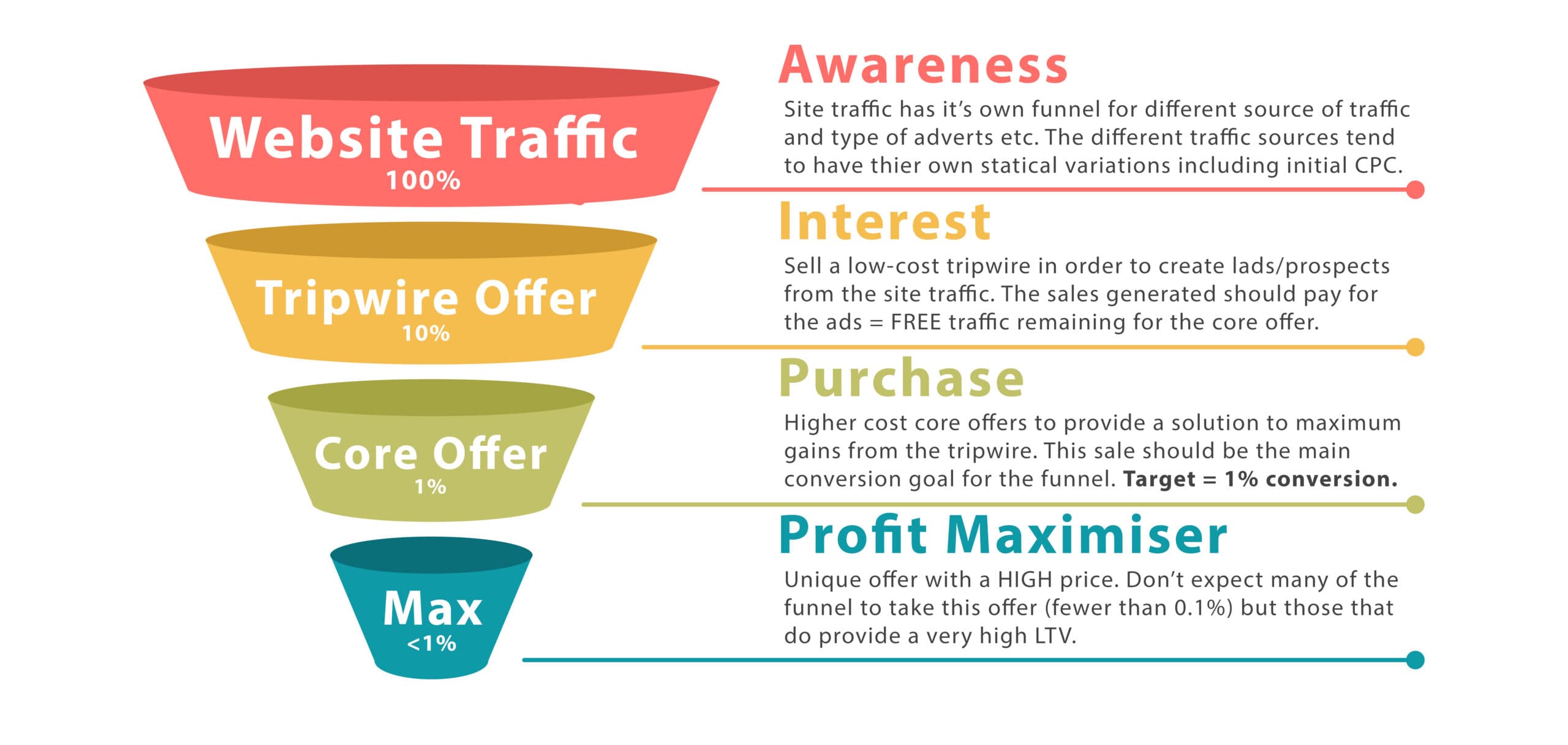
How to optimise your website’s sales funnel
Optimising a website’s sales funnel is important for maximising conversion rates and revenue. Here are a few important strategies to help you do just that!
1. Create a great landing page
The landing page serves as the initial interaction with potential customers. Therefore, the design should be visually appealing, have a clear message, and include compelling calls to action.
2. Present an irresistible front-end offer
Provide something of value at the beginning, such as a complimentary eBook, a discount code, or a trial period at no cost. This encourages visitors to begin the process of entering your funnel.
3. Upsell, cross-sell, and down-sell
Following the initial freebie, consider providing related products or services to enhance the average transaction value. Furthermore, it is advisable to offer alternative options to customers who may have been considering cancelling their purchase.
4. Create measurable goals
It is important to establish specific, measurable, and achievable goals for each stage of your funnel. This allows for the monitoring of progress and the implementation of data-driven enhancements.
Sales funnel use examples
Let’s explore some examples of sales funnels and how they’re used.
E-commerce Funnel
An online retailer typically follows a funnel process that includes product discovery, cart addition, checkout, and post-purchase upsells and email marketing.
SaaS Funnel
A software-as-a-service company may use a sales funnel that starts with a free trial sign-up. The customer then moves on to paid subscriptions. Finally they are tempted with feature upgrades and customer retention initiatives.
Consulting Funnel
A consultant typically follows a funnel model that begins with a free consultation. This initial consultation progresses to a proposal submission to the potential customer and ends with a signed contract for their services.
When to use sales funnel software to help
If you want to efficiently handle and streamline your sales funnel, it is advisable to use dedicated software, especially when:
- Your funnel consists of multiple complex stages and touchpoints.
- You need to monitor user behaviour and analyse data in order to optimise your funnel.
- -You need to segment and target your audience with personalised messages.
- You are seeking to optimise repetitive tasks and enhance productivity.
Some popular sales funnel software options include:
- ClickFunnels – https://www.clickfunnels.com/
- Leadpages – https://www.leadpages.com/
- ActiveCampaign – https://www.activecampaign.com
- GetResponse – https://www.getresponse.com
Benefits of a successful sales funnel
A well-optimised sales funnel used as part of your marketing campaigns can offer multiple benefits to your sales cycle and improve your customer experience:
- Conversion rates improve
- There is an increase in revenue and customer lifetime value
- Improved customer retention
- Enhanced targeting and personalisation
- Improved customer relationships and trust (better customer service)
- Happy customers during their buying process
What else can you use a marketing funnel for?
In addition to sales, marketing funnels can serve multiple purposes such as:
– Building brand awareness
– Generating leads
– Nurturing relationships
– Educating your audience
– Promoting events or webinars
– Email address collection to run future email campaigns
How to build a sales funnel from scratch
Creating a sales funnel from scratch involves several steps:
Define Your Target Audience:
Identify your ideal customers and their pain points.
Create Compelling Content:
Develop valuable content that attracts and engages your audience.
Design Landing Pages:
Build visually appealing, conversion-focused landing pages.
Set Up Marketing Automation:
Use email marketing and automation tools to nurture leads and consider using email drip campaigns
Analyse and Optimise:
Continuously analyse data and make improvements to your funnel looking into your current customers and how they interacted with your funnel/s. Consider gathering feedback by using dedicated email campaigns in order to make changes until you have the most effective sales funnel you can achieve.
Value Ladder Example

Similar to the sales funnel try to get people to move through your sales ladder from the smallest sale to the largest sale.
Sales funnel FAQs
What is the main goal of a sales funnel?
The primary objective of a sales funnel is to lead potential customers through a structured journey that results in conversion.
Is a sales funnel applicable to all businesses?
Yes, sales funnels can be adapted to fit various business models and industries. Tailoring your funnel to your specific goals and target audience is key.
How long does it take to see results with a sales funnel?
The time it takes to see results with a sales funnel can vary widely depending on factors such as your industry, marketing efforts, and the complexity of your funnel. It’s important to be patient and consistently optimise your funnel for better results over time.
Conclusion: What is a sales funnel and how do they work?
In conclusion, understanding the concept of a sales funnel is crucial for every business looking to succeed in their marketing efforts.
By mapping out the different stages of customer engagement, from awareness to conversion, businesses can effectively target and nurture potential leads. With the right strategies and tools in place, a sales funnel can greatly optimise the sales process, increase conversions, and ultimately boost revenue.
However, it is important to continuously analyse and improve the funnel based on customer feedback and market trends to ensure its effectiveness in a constantly evolving business landscape. By embracing the power of sales funnels, businesses can streamline their marketing efforts and set themselves up for long-term success.


